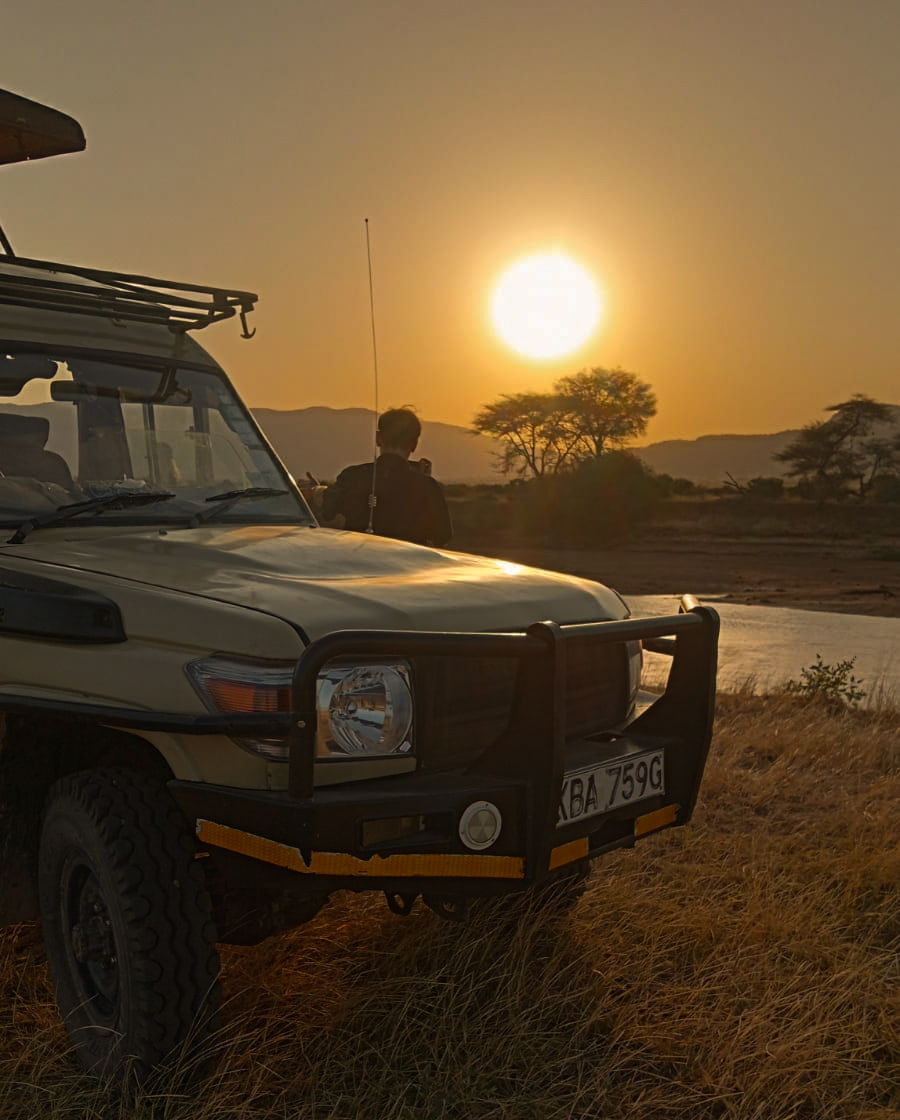
This itinerary is built for a different traveller than our wildlife-focused routes: one who wants time to actually get the shot, and a real conversation with the Maasai community rather than a five-minute stop. It covers three destinations most Kenya itineraries skip entirely, dry, dramatic Samburu with its own set of species found nowhere else in the country, Ol Pejeta’s black rhino sanctuary, and three nights in the Masai Mara, priced from $2,550pp in low season with a dedicated photography-briefed guide throughout. Here’s what each of the 8 days actually involves.
Last updated September 2026.
Day 1: Nairobi to Samburu National Reserve
Your guide collects you from your Nairobi hotel or JKIA early in the morning for the drive north through the Laikipia highlands, a landscape that shifts from green highland farmland into semi-arid bush country as you go. It’s a full driving day, roughly 350km and 6 to 7 hours, so you arrive at Samburu in time for an afternoon game drive rather than a full day. The Ewaso Ng’iro River is the park’s lifeline and the best spot to photograph elephant and leopard coming down to drink. Dinner and overnight at your lodge.
Day 2: Full Day in Samburu
A full day dedicated to Samburu, starting with a pre-sunrise drive when the light across the Mathews Range is at its best. This is where you look for the Samburu Special Five, reticulated giraffe, Grevy’s zebra, beisa oryx, Somali ostrich and gerenuk, none of which you’ll find in the Mara or Amboseli. After a midday break at camp, an afternoon drive takes you back to the riverbank, with sundowners out in the bush before dinner.
Day 3: Samburu to Ol Pejeta Conservancy
A morning game drive in Samburu, then a shorter transfer, around 140km and 2.5 to 3 hours, to Ol Pejeta Conservancy in Laikipia. Ol Pejeta holds the largest population of black rhino in East Africa, and is also home to Najin and Fatu, the world’s last two northern white rhinos, kept under 24-hour armed guard. You check in and head straight out for an afternoon game drive focused on rhino tracking. Dinner and overnight at camp.
Day 4: Full Day in Ol Pejeta
A full day in the conservancy, with a morning drive targeting rhino, lion and Ol Pejeta’s large buffalo herds. There’s an optional visit to the Chimpanzee Sanctuary, a rescue centre for chimps confiscated from the illegal wildlife trade and Kenya’s only place to see chimpanzees. An afternoon drive as the golden light returns rounds out the day. Dinner and overnight.
Day 5: Ol Pejeta to Masai Mara
This is the longest driving day of the trip: around 400km and 7 to 7.5 hours through the Rift Valley, with a stop at an escarpment viewpoint for landscape photography along the way. It’s a genuinely long day in the vehicle, so we’d rather you know that going in than be surprised by it. You arrive at the Mara in time for a late-afternoon game drive as the sun gets low, your first encounters with the open plains, lion prides and the herds of wildebeest and zebra. Dinner and overnight at your camp.
Day 6: Full Day Game Drives in the Masai Mara
The Mara gets a full day to itself, with a predawn departure for the morning drive when the light and the cat activity are both at their best. Your guide works the reserve’s known territories for lion and other big cats, and an afternoon drive across the open plains leaves time to position for sunset. If you’re travelling between July and October, this is when the Great Migration river crossings are most likely. Dinner and overnight at camp.
Day 7: Maasai Village Visit & Final Mara Drive
A morning game drive, then after breakfast a visit to a Maasai village on the edge of the reserve. This is framed deliberately as a genuine cultural exchange rather than a staged performance: you meet elders and community members, hear about the Maasai way of life and its relationship with the surrounding wildlife, and ask questions rather than just watch a show. A final sunset drive and farewell dinner at camp close out the day.
Day 8: Return to Nairobi
One last dawn drive before breakfast and check-out, then the drive back to Nairobi, around 5 to 6 hours. Your guide drops you at your Nairobi hotel, the airport, or any city-centre location.
How Long Are the Drives?
This route covers ground most Kenya itineraries don’t, so the driving is a bigger part of the trip than on a Mara-only or Amboseli-Mara route. Two days are worth planning around.
| Leg | Approx. distance | Approx. drive time |
|---|---|---|
| Nairobi → Samburu | ~350 km | 6–7 hrs |
| Samburu → Ol Pejeta | ~140 km | 2.5–3 hrs |
| Ol Pejeta → Masai Mara | ~400 km | 7–7.5 hrs |
| Masai Mara → Nairobi | ~270 km | 5–6 hrs |
The Ol Pejeta to Masai Mara leg is the longest single day of driving on any of our itineraries. It’s broken up with a stop at a Rift Valley escarpment viewpoint, but it’s still a full day in the vehicle. If that’s more than you want, our 8-day Classic safari covers Amboseli, Naivasha, Nakuru and the Mara instead, with no single leg longer than 5 hours.
Where You’ll Stay
Accommodation is pre-arranged and included in your package price, on a full-board basis throughout.
| Location | Property | Nights |
|---|---|---|
| Samburu National Reserve | Samburu Simba Lodge | 2 |
| Ol Pejeta Conservancy | Comfort Gardens Ol Pejeta | 2 |
| Masai Mara National Reserve | Zebra Plains Mara Camp | 3 |
Pricing by Season
Unlike our other itineraries, pricing on this safari varies by travel date rather than staying fixed year-round. All rates are per person in USD, based on two travellers sharing.
| Season | Travel Period | Per Person (Sharing) | Single Supplement |
|---|---|---|---|
| Low Season | Jan 1 – Mar 31 | From $2,550 | +$480 |
| Green Season | Apr 1 – Jun 30 | From $2,700 | +$480 |
| Peak Season | Jul 1 – Oct 31 | From $3,450 | +$500 |
| Low Season | Nov 1 – Dec 22 | From $2,550 | +$480 |
| Festive Season | Dec 23 – Dec 31 | From $3,600 | +$500 |
Solo, family and group rates are available on request.
What’s Included
- Private 4×4 safari jeep with pop-up roof
- Professional English-speaking guide/driver, briefed for photography
- All park and conservancy entrance fees
- Accommodation as per itinerary (7 nights, full board)
- All meals at camps and lodges
- Drinking water during all game drives
- Maasai village cultural visit
- Ol Pejeta Chimpanzee Sanctuary entry
- Airport/hotel pick-up and drop-off in Nairobi
- PMK 24/7 support throughout
What’s Excluded
- International flights
- Kenya visa/eTA fees
- Travel insurance (strongly recommended)
- Tips for guides and camp staff
- Personal expenses and souvenirs
- Hot air balloon safaris (optional add-on)
- Alcoholic beverages
- Professional photography equipment hire
Best Time to Go
This itinerary rewards timing more than most. Peak season (July to October) puts you in the Masai Mara during the Great Migration, when river crossings are possible, but it’s also the most expensive time to travel and the busiest in the Mara specifically. Samburu and Ol Pejeta are good year-round and far less crowded than the Mara at any time. If low prices and quieter parks matter more to you than migration odds, January to March or November to late December are worth considering. For a deeper look at Mara timing specifically, see our best time to visit the Masai Mara guide. Pack layers for cold Samburu and Mara mornings and hot, dusty afternoons — our what to wear on a Kenya safari guide covers it.
Ready to Book?
This safari runs on private dates, with pricing that varies by season as shown above. See full details and get a quote on the 8-Day Kenya Culture & Photography Safari page.
Frequently Asked Questions
What’s the difference between this and the 8-Day Classic safari?
This itinerary swaps Amboseli, Naivasha and Hell’s Gate for Samburu and Ol Pejeta, both destinations focused on species and wildlife you won’t find further south, plus a genuinely deeper cultural visit and a photography-briefed guide throughout. The trade-off is longer driving days, including the longest single transfer of any of our itineraries.
How long is the drive from Ol Pejeta to the Masai Mara?
Around 400km and 7 to 7.5 hours, broken up with a stop at a Rift Valley escarpment viewpoint. It’s the longest single travel day on any of our itineraries, so it’s worth knowing about before you book.
What are the Samburu Special Five?
Five species found in Samburu’s dry northern habitat and largely absent from Kenya’s other major parks: reticulated giraffe, Grevy’s zebra, beisa oryx, Somali ostrich and gerenuk. They’re a key reason photographers add Samburu to a Kenya itinerary.
Can I really photograph the last northern white rhinos?
Yes. Najin and Fatu, the world’s last two northern white rhinos, live at Ol Pejeta Conservancy under 24-hour armed guard, and this itinerary includes a rhino-tracking game drive there.
Does pricing really change by season?
Yes, unlike our other itineraries, this one is priced seasonally: from $2,550pp in low season (January–March, November to December 22) up to $3,450–3,600pp in peak and festive season (July–October, and December 23–31), reflecting demand and accommodation rates at each destination.
Is the Maasai village visit staged for tourists?
It’s designed not to be. The visit happens on Day 7 on the edge of the Mara, framed around meeting elders and community members and asking genuine questions about their way of life, rather than a performance built purely for photographs.
Do I need a visa to visit Kenya for this safari?
Most nationalities need an eTA (electronic travel authorisation) applied for online before you travel. See our Kenya visa requirements guide for the current process.
Should I bring my own camera gear?
Yes, professional photography equipment hire isn’t included, so bring your own body and lenses. A telephoto lens (300mm or longer) is worth prioritising for Samburu and Mara wildlife, though the itinerary works well with a smartphone too, since it’s built around time and access rather than gear.
Leave a Reply