Booking a safari for a company retreat, an incentive trip, or a conference add on is a different job than booking for a couple or a family. Someone has to answer for vehicle capacity across a group of thirty, make sure invoicing works the way finance needs it to, and know that if one vehicle breaks down on a dirt road two hours from camp, there is a backup plan already in place. This is what that planning actually looks like, from an operator who runs these trips regularly rather than occasionally.
Why Kenya works for corporate incentive and retreat travel
A safari solves a problem that most standard incentive destinations do not: it gives a group something genuinely memorable to talk about afterward, rather than a nice hotel and a golf course that blur into every other trip. Watching a lion pride at close range with your team is the kind of shared experience that actually gets referenced back at the office months later, which is usually the point of an incentive trip in the first place.
Kenya specifically has the infrastructure to support this at a corporate scale. Nairobi has direct flights from most major hubs, a mix of international conference facilities and safari lodges within a short flight or drive of the city, and enough camp and lodge capacity in the Maasai Mara and surrounding parks to accommodate larger groups without splitting them across multiple, disconnected properties. That combination, real wildlife plus workable logistics, is harder to find than it sounds.
Group size considerations: vehicle capacity, convoy logistics, camp and lodge group capacity
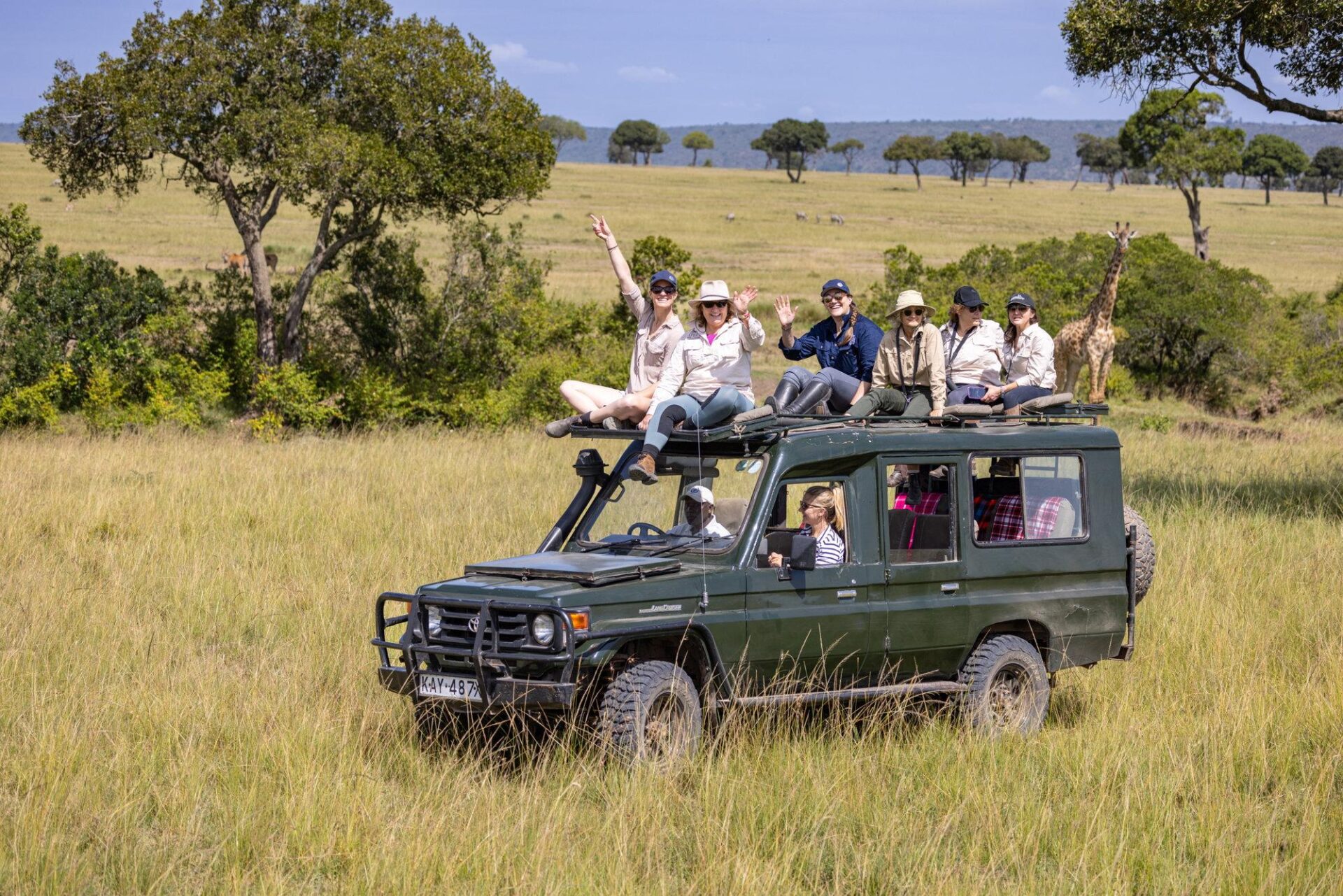
Most safari vehicles seat six to seven guests comfortably with window access for everyone, which is the actual limiting factor, not seatbelts. A group of twenty typically needs three to four vehicles, and a group of forty needs six to seven. Beyond that, we run radio linked convoys so vehicles can coordinate on sightings and stay together on transfer days, and we assign a lead vehicle that handles route decisions and communicates with camp on arrival times.
Camp and lodge capacity is the other constraint, and it is worth flagging early because it is where group trips go wrong if nobody checks. Many camps in the Maasai Mara max out at twenty to thirty guests total, so a corporate group of that size can effectively fill a mid-sized camp, which is good for group cohesion but means booking needs to happen well ahead of your travel dates, especially in peak season from July through October. Larger groups sometimes split across two nearby camps rather than one, which keeps everyone in the same area for joint activities while working within what any single property can actually hold.
Corporate booking logistics: invoicing, deposits, group contracts
This is usually the part that determines whether a company can actually book with an operator, regardless of how good the itinerary looks. We work with a group contract that locks in per person pricing once numbers are confirmed, a deposit structure that is typically a percentage down to hold vehicles and camp space with the balance due closer to travel, and a single consolidated invoice that finance departments can process the same way they would any other vendor invoice, rather than a stack of individual guest receipts.
We can also handle a company purchase order process, provide W-9 style documentation where relevant, and adjust group numbers within a reasonable window before final payment, since headcounts for retreats and incentive trips have a habit of shifting right up until the deadline. None of this is unusual for us. It is the normal shape of a group booking, and it is worth asking about directly if you are the one who has to justify the expense internally.
Team building activities that work well in a safari setting
A safari does a lot of the team building work on its own, since shared game drives, meals around a communal fire, and the general novelty of the setting tend to break down office hierarchy faster than a planned icebreaker does. A few structured additions worth considering on top of that:
A private bush dinner or sundowner event, set up away from camp with its own staff and setup, works well as an opening or closing night event for the whole group.
A guided walking safari, where available and age and fitness appropriate, gives smaller breakout groups a different pace and a chance for quieter conversation than a vehicle allows.
A Maasai village visit or cultural exchange gives the group a shared, low pressure activity that works for people who are not naturally outdoorsy and want something more conversational.
A hot air balloon safari is a genuine highlight for a group that wants one big, photograph worthy shared moment, priced per person and bookable as an optional add on for those who want it.
Sample 4 day and 7 day corporate itineraries
For a shorter retreat or a conference add on, a 4 day itinerary usually runs Nairobi arrival, transfer to the Maasai Mara the same or next morning, two full days of game drives with a sundowner or bush dinner event on one evening, and a return to Nairobi on the final day in time for evening flights. It is a tight but complete safari experience that does not require extending anyone’s time away from the office by much.
For a fuller incentive trip or an extended retreat, our 8-Day Classic Kenya Safari gives a group Amboseli’s elephant herds against Kilimanjaro plus several days in the Maasai Mara, with a rest day built in at Lake Naivasha or Lake Nakuru that doubles well as a scheduled downtime or optional-activity day for a corporate group. For a group that wants more ground covered and more variety across the week, our 10-Day Kenya Safari works at a similarly manageable daily pace, just with two additional parks folded in.
Budgeting for group safaris, with a per person cost breakdown at different group sizes
Group pricing generally improves as numbers grow, since vehicle and guide costs spread across more people and camps often offer group rates on room blocks. As a rough guide, mid-range group safaris in Kenya run somewhere between 1,200 and 2,800 dollars per person depending on trip length, camp category, and group size, covering accommodation, meals, park fees, game drives, and road transfers.
A group of ten to fifteen typically sits toward the higher end of that range, since fixed costs like a lead vehicle or a private event setup are shared across fewer people. A group of thirty to fifty usually lands toward the lower end per person, since those same fixed costs and any negotiated camp group rate get spread further. Our Kenya safari cost guide breaks pricing down further by trip length and lodge category, and it is worth requesting an exact group quote once you have a firm headcount, since final numbers move with camp availability and season.
Working with a travel agent or planner versus booking direct with PMK
Both paths work, and which one makes sense usually comes down to who inside the company owns the planning. If you already work with a travel agent or event planning firm for other corporate travel, we operate a dedicated travel agent partnership program with trade pricing and direct operator support, so your agent can build the itinerary through us without losing their usual commission structure.
If nobody on the team has an existing agent relationship, booking direct with PMK works just as well and cuts out a layer of back and forth, since you are dealing straight with the operator who runs the vehicles and holds the camp bookings. Either way, the logistics, invoicing, and on the ground support are the same. It is really a question of who you want managing communication on your side.
Common questions
What is the minimum group size for a corporate safari? There is no strict minimum, we run trips from small executive groups of six or eight up to fifty or more, though pricing and vehicle logistics scale most efficiently from about fifteen people up.
Does a single supplement apply to solo attendees on a group trip? Usually not in the same way it would for an individual traveler booking alone. Group rates are typically built around twin share rooms, and a company can choose to cover the modest single room upgrade for attendees traveling without a roommate, or let attendees pair up.
Can dietary restrictions and accessibility needs be accommodated across a large group? Yes. Camps in Kenya routinely handle a full range of dietary requirements, vegetarian, vegan, halal, allergies, and so on, but they need advance notice for a group of any size, so we collect this information from every attendee before final camp confirmation, not on arrival.
You can read more about how we run larger trips on our About Us page. When you are ready to start planning, get in touch with your group size and rough dates, and we will put together a logistics plan and quote built around your numbers.
Leave a Reply